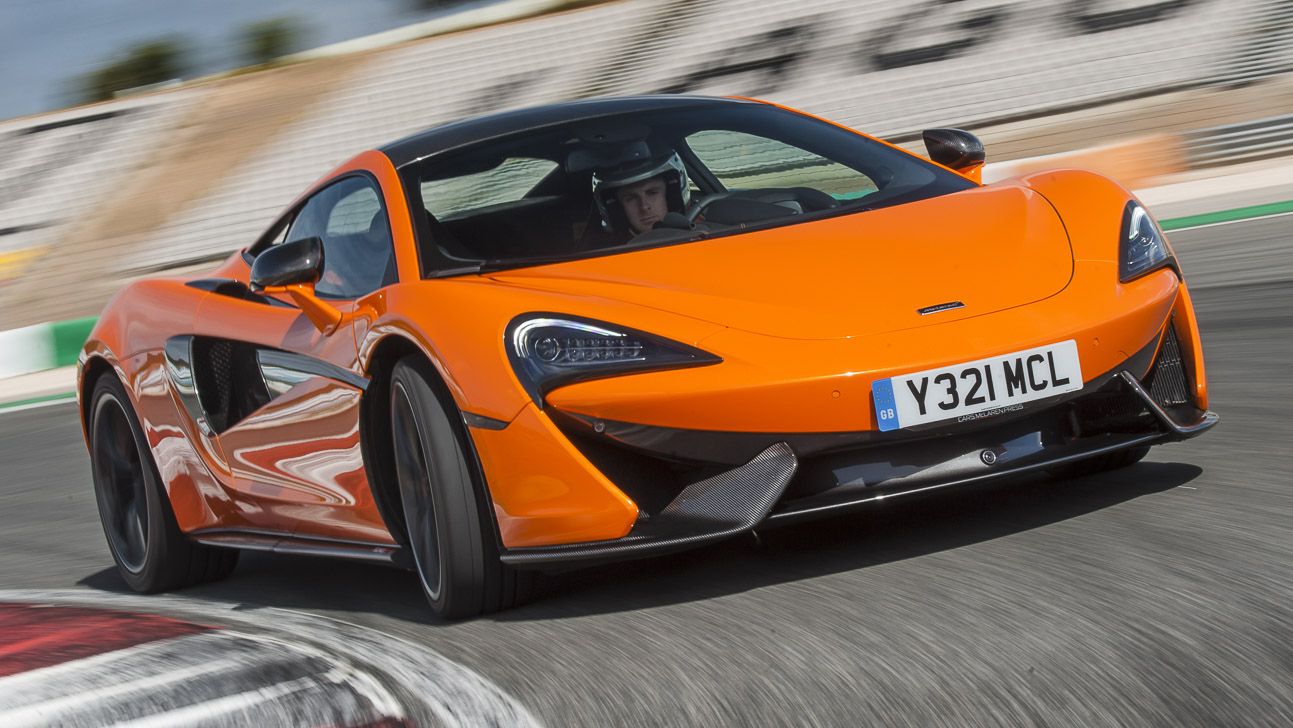
This year at the New York Auto Show Mclaren revealed their new “entry level” sports car, the 570S. It produces 562 hp from a 3.8-liter twin turbo V-8, and starts at $184,900. While Mclaren is far from an entry level manufacturer in the super car world, I can’t help but laugh at the idea of this being labeled an entry level sports car with a power output to rival an AMG tuned Mercedes. Consider that just ten years ago in 2005 Aston Martin revealed their entry level sports car, the V8 Vantage. From its inception it made 380 horsepower from 4.3-liter V-8 and cost around $110,000. Of course since then the V8 Vantage has spawned other variants with V-12’s making up to 565 horsepower, so right around the mark of the Mclaren 570S. In ten years our expectation of what we get out of a six figure entry level sports car has risen by almost 200 horsepower, and that’s just one example from this year.
On the opposite end of the spectrum we have companies like Koenigsegg who recently revealed the Agera RS (1160 hp) and the Regera (1500 hp), two insane limited production million dollar hypercars. Take a look back at hypercars from the past couple decades; Mercedes CLK-GTR (600hp), Jaguar XJ220 (540hp), Bugatti EB110 (560hp). Power outputs have doubled and almost tripled. What are hypercars going to need in ten years to be competitive? 2,000+ horsepower?

It’s not just prestigious super cars that are seeing a large inflation of power outputs. Take a look at America’s most popular muscle cars right now, the Hellcat twins. The Charger and Challenger Hellcats both make 707 horsepower, will hit 200 mph, and cost under $70,000. 707 horsepower in a four door American sedan for that kind of money is crazy, such power outputs usually demand the high sticker price of a BMW M5 of Mercedes E63 both of which make substantially less power than the Hellcats. German super saloons are another great example of high horsepower demands. Any entries in the midsize super sedan market requires at least 500 Horsepower to be considered a worthy attempt at giving any M5/E63/RS6 a run for their money. Lexus just got a bit more serious about going head-to-head with the Germans when they revealed the GS-F. Although, at 467 horsepower, its competitors won’t think twice considering it’s at a nearly 100 horsepower deficit.
Another example that impresses me is the newly proposed Volkswagen Golf R400. Five years ago the idea of putting 400 horsepower through a four wheel drive Golf would have been shelved immediately, just look at the popular hot hatches from around then like the Ford Focus RS Mk. II. Ford put 300 horsepower through the front wheels and ended up with a torque steering wild beast of a focus that could reach almost 170 mph. What does the future of super hatches look like if their power outputs are approaching that of an entry level C7 corvette?

The only recent examples that I can think of that takes things in the other direction are the Toyota GT-86/Scion FR-S/Subaru BRZ triplets. Using a tiny boxer engine making 200 horsepower, Toyota and Subaru have made things simple and created cars that give a fun and sporty feel for enthusiasts without spending a ton of money on a car that can only be fully enjoyed at a race track. You don’t get mind blowing performance or show off levels of acceleration, but what you do get is a truly entry-level everyday sports car.
In no way am I saying that companies should not push the boundaries of their products as technology advances, but there is no denying that there seems to be no stopping these ever increasing horsepower wars. As soon as one car takes a huge leap forward, the rest of the competition must match the mark in order to stay relevant. What kind of machines will we be looking at in another ten years? Will mass production cars with less than 200 horsepower even exist anymore?