

In the ever evolving world of hypercars, 2024 has drawn a new line in the sand for what is shaping up to become the second iteration of the “holy trinity” hypercars, but one question remains; Where is Porsche? First McLaren dropped the W1, their successor to the highly acclaimed P1. Then Ferrari dropped their F80 flagship supercar to follow up on the LaFerrari. Naturally, enthusiasts were waiting for Porsche to drop the covers on a production version of the fully electric Mission X concept, acting as a successor to the 918 Spyder. Meanwhile, Aston Martin, a brand not typically associated with dominating the hypercar sub-market, revealed the long awaited production version of the Valhalla. Did Aston Martin just unexpectedly take the third spot of the new trinity alongside McLaren and Ferrari?


The Valhalla’s Origin Story
The production Valhalla has changed considerably since it first debuted as the AMRB 003 concept at the 2019 Geneva auto show. Aston Martin made their intentions clear that they wanted to produce a hypercar of their own for the 1000+ horsepower category, but we have all seen how ambitious concept vehicles can silently fall into the background never to be followed up on (looking at you, 2010 Lotus concept cars). Many people may have brushed off the AMRB 003 as an interesting distraction, especially with the Valkyrie and Valkyrie AMR Pro models occupying most of Aston Martin’s spotlight at the Geneva show. Afterall, the same auto show also included a mid-engine Vanquish concept car which was intended to compete with the Ferrari F8 and McLaren 720S, but that project would later be cancelled by Aston Martin.
At the time, Aston Martin claimed that the AMRB 003 would reach production around 2021 and feature a twin turbo V6 hybrid powertrain developed in house. Fast forward to 2021 and while the Valhalla had not reached its production target, Aston Martin revealed a heavily revised prototype model of the Valhalla, which ditched its V6 engine for a twin turbo V8 unit. Aston Martin now claimed that Valhalla customer deliveries would begin in late 2023. Now, here we are in December 2024, and the production ready Valhalla should finally start reaching customers in 2025.
The New Contenders
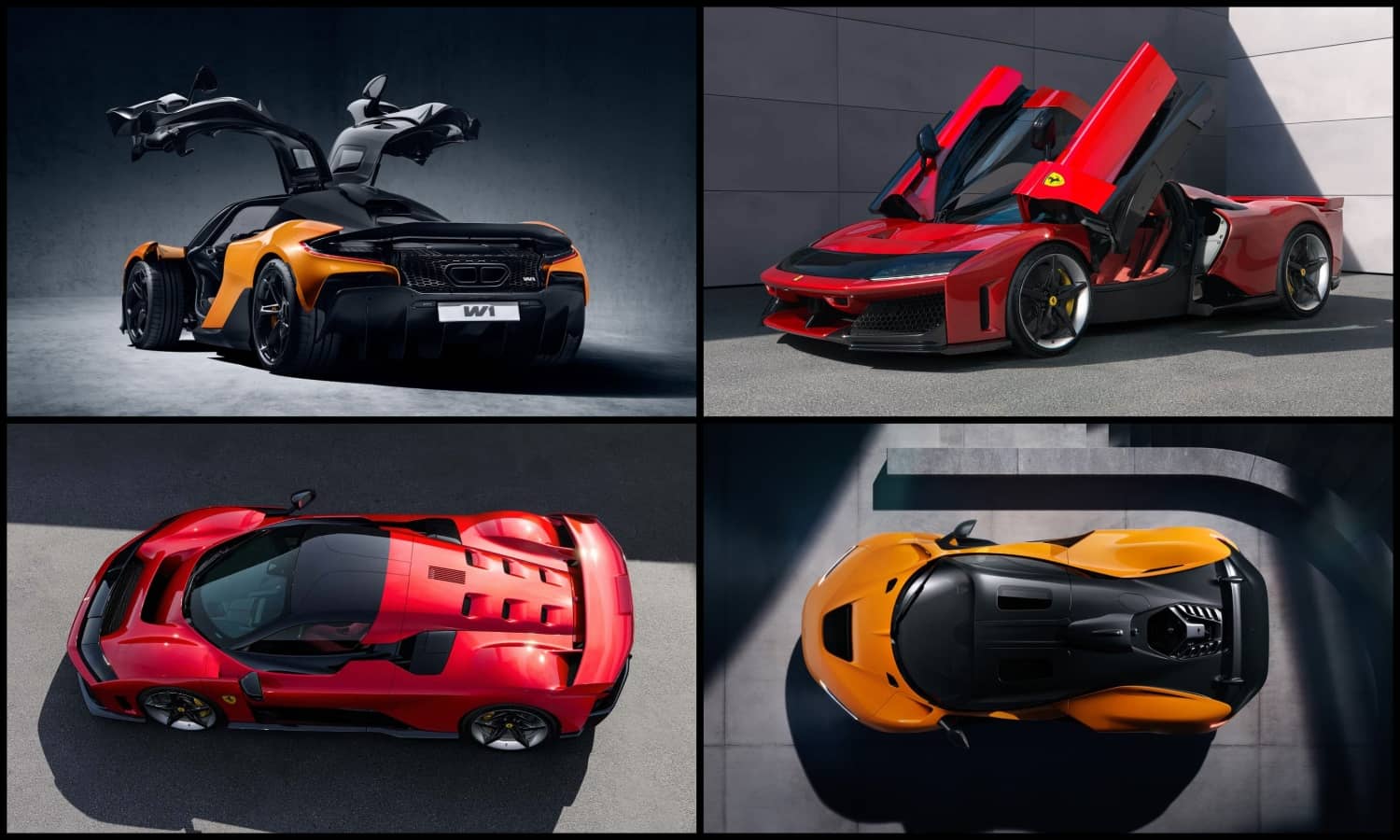
Replacing the icons of a decade ago, the Ferrari LaFerrari, McLaren P1, and Porsche 918 Spyder, is no small feat. The recent emergence of the McLaren W1 and Ferrari F80 raises an intriguing question; do these hypercars truly push the boundaries of innovation and performance as much as the first holy trinity? While their engineering is undeniably top notch, comparisons to the LaFerrari, P1, and 918 Spyder suggest that the bar for groundbreaking technology may not have been surpassed by as wide of a margin as expected.
The plug in hybrid McLaren W1, boasting over 1,200 horsepower from a twin-turbo V8 and an electric motor, represents McLaren’s most advanced engineering to date, while still feeling very familiar to other hypercars within their own back catalog. The W1 sends power to the rear wheels, features new gullwing doors, and can provide a small amount of electric only driving. With a 217 mph top speed and a 0-60 mph time of just 2.7 seconds, the W1 delivers a winning formula, but at the same time, it doesn’t bring anything that new to the table. More so, it feels like a second generation P1 model, instead of a new generation that defines a higher benchmark.
Meanwhile, the Ferrari F80 continues the brand’s legacy by leaning into motorsports inspired powertrains with its hybridized V6 engine that draws inspiration from Ferrari’s motorsport programs, including the Le Mans winning 499P hypercar and the powertrain technology from their Formula 1 team. The F80’s total power output is claimed to be 1184 horsepower, achieving 0-60 mph below 2.3 seconds, with a top speed of 217 mph. Ferrari has also emphasized aerodynamics, leveraging active aero components to deliver unparalleled stability at high speeds. The F80 actually feels more reminiscent to the Ferrari F50 than it does the Laferrari, because the F50 was also a motorsports based creation that used F1 an inspiration, where as the F80 is inspired by Ferrari’s current success at Le-Mans with the 499P.
Then there’s the Aston Martin Valhalla, a surprise addition to the ranks. Powered by a plug-in hybrid twin turbo V8 engine sourced from Mercedes-AMG, it produces 1064 total horsepower. The powertrain and motorsports inspired aerodynamics provide performance stats that put in within range of the W1 and F80, reaching 0-60 mph in 2.5 seconds and top speed of 217 mph. The Valhalla will also support an electric only driving range of 9 miles, just enough for some stealthy starts before escaping to the B-roads.
Porsche’s Temporary Absence
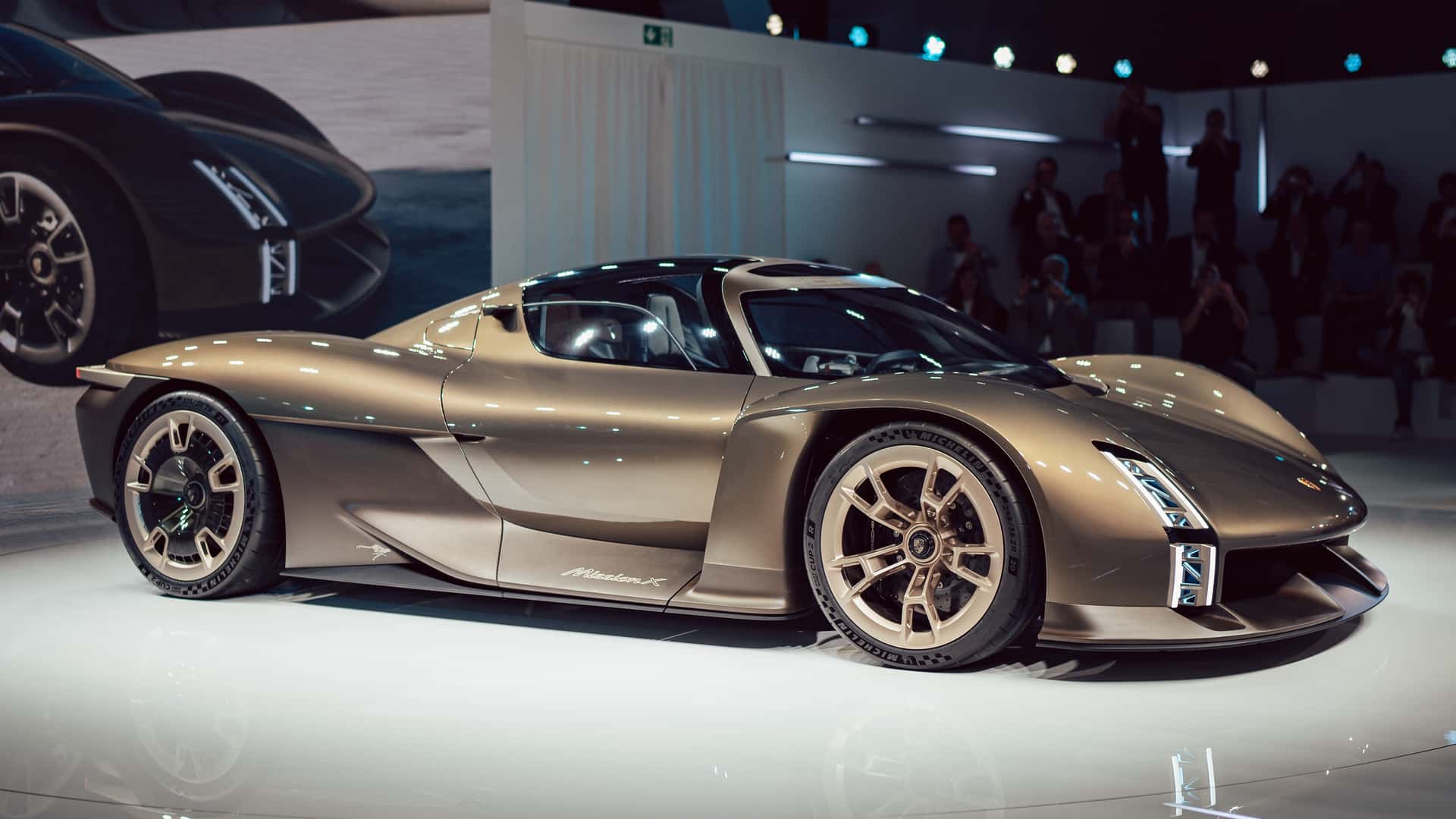
So with 2024 coming to a close, and three brand new, million dollar, plug in hybrid hypercars fully revealed, what can we expect from the legendary Stuttgart performance brand? For years, enthusiasts anticipated that Porsche would unveil a production version of the Mission X concept to compete in this new hypercar arena. The Mission X, revealed in concept form in 2023, promised groundbreaking performance and sustainability. With its sleek design and rumored specs suggesting over 1,000 horsepower and a focus on all-electric propulsion, the Mission X seemed destined to continue the Porsche supercar line, but with a drastic shift in execution.
Porsche insiders have hinted that the Mission X project is still in development, with a possible debut around 2025. However, recent rumors suggest that Porsche is reconsidering its fairly aggresive EV push, with projects like the electric 718 successor, Cayenne EV, and the Mission X concept, all on the table for changes in their product strategy. Of course, the potential changes being considered are likely a result of slowing Porsche Taycan sales, and other EV hypercar market signals like the Rimac Nevera struggling to sell, and the Lotus Evija hype decreasing. This potential pivot with Porsche has left a void that Aston Martin has suddenly filled by providing full production specs for the long awaited Valhalla. While the Valhalla project was initially seen as an outsider, and became victim to multiple rollout delays, the new hypercar is actually better positioned to fit into the holy trinity than Porsche.
It may seem strange to consider the Valhalla in the same space as the W1 and F80, especially because this is Aston Martin’s first entry into this specific segment of mid-engine performance cars, where as Porsche, Ferrari, and McLaren all have their own established bloodlines dating back to the 959, 288 GTO, and F1 respectively. Aston Martin, a brand that typically spends its time avoiding bankruptcy, has never had a collection of supercars that brand enthusiasts chase after. You could perhaps consider the 2011 Aston Martin One-77 their first limited series supercar, but it occupied an entirely different genre of front engined super grand tourers. Same can be said of the Aston Martin Vulcan, offering an unexpected and highly limited track only alternative to vehicles like the Pagani Zonda R or Ferrari’s XX program vehicles.
However, maybe time will look kindly on the Valhalla and this period in Aston Martin’s history, with insane high performance creations like the Valkyrie, Victor, Valour, and Valiant, alongside their presence in Formula 1 and their upcoming return to Le-Mans in 2025 with the Valkyrie AMR-LMH. If the Valhalla receives praise from owners and journalists, perhaps it will become the first in a future bloodline of Aston Martin mid-engine supercars. Either way, Aston Martin has delivered a conversative, but compelling answer to the McLaren W1 and Ferrari F80. In my opinion, the Valhalla’s design is also stronger than the W1 and F80. Porsche has some big shoes to fill and they could certainly turn the Mission X into something that blows the Valhalla out of consideration in the new holy trinity, but for now, we have three new hybrid powered hypercars carrying the torch forward.